The Mindspace
Subscribed: Pay to play for social and apps
by Cody Toombs Published on January 28, 2023
A lot of people are talking (again) about their willingness to spend money on subscriptions to apps, social networks, news, and other works that many people have become accustomed to accessing for free. Given the current economic situation, this discussion has become increasingly pervasive as many people are looking to cut costs in the face of a recession or job loss.
While this topic is always perpetually swirling, the specific circumstances that have resurfaced it are linked to the rise of Mastodon as the prevailing experiment in anti-centralized social networking and the sudden influx of app developers attempting to bring high-quality products to the table. The specific example that sparked conversations is centered on the release of Ivory for Mastodon, built by TapBots, and the pricing model that calls for a $2/month (or $15/year) subscription fee.
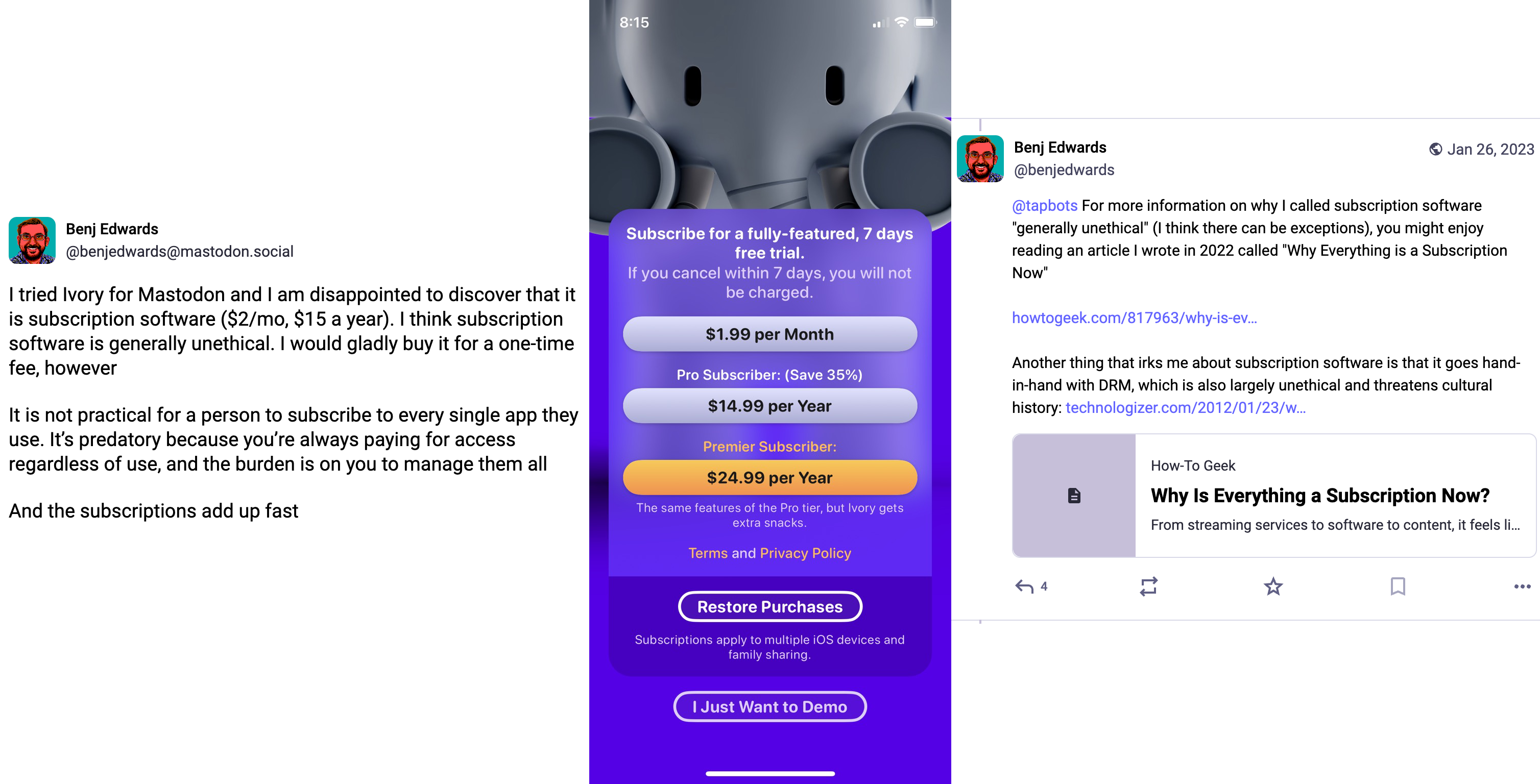
Let's talk about App.Net
Almost exactly a decade ago, in mid-2012, App.net announced plans to start a fee-based social network that aimed to charge $5/month. At the time, there was plenty of vitriol over Twitter's recent decisions and behavior regarding third-party clients, and a lot of people were looking for an alternative. Funny how history loves to repeat itself...
At the time, App.net managed to garner about 11k backers willing to pre-pay for a year of service, but many other people balked at the notion of paying a fee just so they could generate the content that would be used to compel more users to join and pay the same fee. Of course, App.Net attempted to counter this with a free tier, but that did little to attract new users. While the story winds around a few corners, App.net never grew beyond its status as an also-ran, and ultimately met its demise in March 2017.
We could argue all day long about whether this was the fault of the business model, or if the masses are just too hard to move away from the social network they're already invested in, or even if rumors are true that Twitter paid for a smear campaign, but the simple truth is that the first pay-to-play social network was shut down after about four and a half years.
On to Mastodon
Here we are, 10 years later and Twitter has gone the way of Musk's dystopian fantasy — all expect the part where he claimed he could make it profitable by letting hateful people return so they could annoy, torment, and threaten the users that were actually valuable to advertisers... lol
Seriously. lol...
Anyway, you would have to be pretty closed off from the news cycle (at least tech news) to have missed the stories about people quiting Twitter en masse, and the numerous surges of new users hitting the many disparate Mastodon servers and bringing most of them almost to the brink of collapse — classically thought of as a good sign by most of Silicon Valley, but less so when very nearly all of them are run by people as a hobby.
In responsible consideration of the costs and time associated with running a server to host thousands of users and data from a rapidly growing number of instances, you can't go for long without seeing Mastodon advocates post yet another reminder to donate a few bucks to the server admins. The smart ones suggest ongoing donations, and \$3/month seems to be the popular guideline, but there are also a lot of people that think it's enough to "buy the developer a cup of coffee" for $5 and pretend it lasts into perpetuity. We'll see how long that lasts... [edit: it seems like it hasn't fared very well]
The same old story about app subscriptions
At the moment, I don't care to relitigate this age-old topic. But I believe most informed people can agree, building and maintaining modern software is no longer a one-and-done proposition, and therefore it has continuing costs. At a bare minimum, many apps aren't even allowed to remain on modern app stores if they don't support at least one of the most recent OS versions, and some app developers have to jump through several hoops with each OS release to ensure their apps remain compatible.
Some developers have been able to get away with one-time pricing on apps by virtue of massive popularity. Sure, if you can build an app that sells a million copies for $1, even after app store fees and taxes, you've made as much or more than a traditional developer job would pay in about five years. Unfortunately, very few app developers can achieve that level of success. Besides, they're probably splitting those proceeds with other developers.
The far more common scenario is that a developer creates an app, prices it between $1 and $3, and they'll sell between a few hundred to a few thousand units, and that's not even enough to live on. For this path to be successful, the developer needs to sell at least tens of thousands of units on an app that didn't take too long to build. From here, they may try to work on the app to increase sales, but it's usually smarter to move onto a new app idea and keep trying to become one of those 7-digit success stories.
And finally, there's the route of subscriptions. For the average developer to make approximately minimum wage income through app subscriptions, they really only need to attract about 3500-4000 users with a monthly price of $1. The important thing is that the income is continual, and hopefully frees them up to work on more projects or improve the existing one in ways that allow them to offer higher-priced subscriptions or attract even more users.
Okay, there's also a business model built around free apps with ads, sponsorships, affiliate sales, or even quietly harvesting and selling user data. I'm not ignoring these strategies, but they become complicated and often become part of the long tail for paid apps once developers realize their original pricing model isn't going to fund years of continued development.
It's not hard to see how subscriptions have become the attractive option for any app developer to maintain a successful, ethical, and sustainable business model.
Did anybody ask the customer?
Therein lies the problem. On one side of the equation, subscriptions sound great. A developer, Mastodon hoster, or other service providers doen't need to charge insane amounts or find a massive customer base to make a reasonable income and continue maintaining their products. Unfortunately, a dollar or two, here or there, sounds trivial in isolation, but they add up quickly, especially when they're paired with common subscriptions like Netflix, Amazon Prime, and those goofy things like electricity and water services — oh, and let's not forget supporting some of your favorite creators. Thanks again to the wonderful people that have been contributing to my work over the last few years!
Most people also feel uncomfortable when they see new line items appearing on their credit card bills and knowing those things will be there next month, and the month after, and so on. A credit card bill with 3-4 pages of recurring charges is sure to wear thin very quickly.
So I find myself wondering, what is the value proposition for customers? Where is that line, and for which things? Do customers feel good about paying for a server that hosts their Mastodon account. What's their stance on paying for an app that makes the experience a little nicer? How many people are paying for these things in addition to dozens of other subscriptions?
I have no idea what the right answer is for the market, but I think we're getting much closer to finding that line. As expenses rise and income doesn't, are we going to see subscriptions failing? Can small and independent projects survive when many customers are feeling a stronger need to reduce their recurring costs? It feels like a bad time to see a service model (Mastodon) pop up with an incentive to pay a regular subscription, followed shortly after by app developers that also want a subscription for their apps, just as streaming services and other providers seem to be raising their prices at a record pace.
Just thinking about it has me feeling exhausted — or maybe that's the lack of sleep? Either way, this trend of pushing consumers to leak more and more money is just as concerning as the 2010s trend of pushing users to leak more and more of their time and attention to social networks. I'll stop short of blaming everything on social networks for pricing users out, but I think they're slowly helping us find a new place where society will eventually hit its limits.